



23.03.2026.
How Drones are Transforming Regeneration

Intro
When fire sweeps through a mountain landscape, the damage visible to the eye is only the beginning. Beneath the ash, a race between regeneration and collapse begins. This is the story of how using agricultural drone technology can make us win that race.
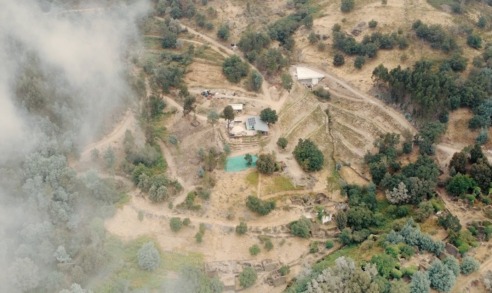
In August 2025 a big part of Serra da Lousã was affected by the wildfire. Most of our 230-hectare land was destroyed. The invasive mimosa and eucalyptus that had colonised sections of the land were gone, a rare silver lining. But so was most of the ground vegetation. What remained was bare, exposed soil on steep, rocky slopes, vulnerable to the full force of autumn and winter rains.
We faced two immediate problems to solve
Erosion
After a wildfire, the land’s most urgent enemy is water. Without grass, shrubs, or leaf litter to intercept rainfall and bind soil particles, even moderate precipitation causes rapid surface erosion. On steep slopes, this can escalate quickly into landslide risk, destabilising hillsides, silting up watercourses, and stripping away centuries of accumulated topsoil.
Invasive mimosa
Acacia mimosa (Acacia dealbata) is one of the most aggressive invasive species in the Iberian Peninsula. It is also pyrophytic (adapted to fire). Its seeds lie dormant in the soil for decades, and the heat of a wildfire triggers mass germination. Within months of a fire, areas that previously had sparse mimosa coverage can become densely carpeted with new seedlings.
If left unchecked, mimosa forms monocultures that exclude native vegetation, alter soil chemistry through excessive nitrogen fixation, and significantly increase fire load for the next burn cycle.
Drone to the Rescue
Conventional hand-seeding of large, steep, and newly unstable terrain within this timeframe is not realistic. The slopes are dangerous to work on, access is severely limited, and the scale of the burned area far exceeds what any team can cover on foot. That’s where the drone came in.
Traditionally carried out using fixed-wing aircraft or helicopters, aerial seeding has been used for decades in large-scale erosion control and post-fire restoration projects across North America, Australia, and parts of Europe.
Agricultural drones represent a fundamentally different approach. Our heavy-lift seeding drone is capable of carrying up to 50 kg of seed per flight, covering approximately one hectare per payload. Crucially, it can operate effectively over terrain that would be inaccessible or dangerous for ground crews, hovering at precise altitudes to optimise seed dispersion and reduce scatter loss on steep slopes.

The advantages over traditional approaches are substantial:
- Terrain independence: The drone reaches cliffs, gullies, and ridgelines that are inaccessible to vehicles or difficult to navigate on foot, especially on freshly burned, unstable ground.
- Speed: A human hand-seeding team can cover a fraction of the area at the same time.
- Precision: Unlike large aircraft, the drone can be directed to specific priority zones, the most erosion-prone slopes, the areas most vulnerable to mimosa colonisation, rather than applying blanket coverage.
- Ownership and readiness: Owning the equipment means we can act immediately after future disturbance events, without dependence on external contractors whose availability during peak demand is never guaranteed.
A Phased Approach: Working with the Seasons
For broadcast seeding to be effective, timing, seed selection, and dispersion precision all matter significantly. Seeds must be applied before rainfall to allow them to be driven into the soil surface, but close enough to expected rain to germinate quickly and establish before erosion becomes severe.
- Autumn to stabilise before the rains.
Fast-establishing grasses, clovers, and nitrogen-fixing legumes went down first. They bind soil quickly, begin rebuilding fertility, and provide the first food source for returning wildlife. These are the natural pioneer species after disturbance, we’re simply accelerating what the land would do itself.
- Winter to map and plan.
Cold temperatures halt germination, so we used this period to survey coverage, identify gaps, and build a precision seeding plan for spring.
- Spring to compete with mimosa.
Fast-growing native plants seeded strategically to shade out mimosa seedlings before they can establish dominance. Not an eradication strategy, an ecological competition strategy.
There’s a long way to go but the early evidence confirms that aerial drone seeding can meaningfully close the critical window between fire and erosion, giving native ecosystems the time they need to recover.
Follow the Full Story
We’ve documented the entire process in our vlogs. Learn more about the learning curve, the mistakes, the workflow, and the first signs of recovery in the latest episode. Already available on YouTube channel.
Help Bring This Mountain Back To Life
If you’d like to support a 50-year mission to regenerate this mountain, join our Patreon community. As Patron you will gain access to regular camera-trap updates, behind-the-scenes moments, and early access to our regenerative vlogs.
08/10/2025
From a Humble Storage to an Off-Grid Basecamp
Learn how we work off-grid as well as the challenges and benefits this way of life brings!
27/08/2025
Serra da Lousã Burned. We Resisted.
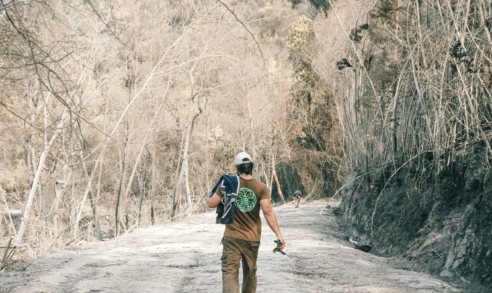
On August 14th, at the peak of a brutal heatwave, a massive fire swept through the mountains of Lousã. In just a few days, over 3,500 hectares of mountain forest were reduced to ash. Our land was no exception.

09/07/2025
Update: Rising Against Illegal Loggers
After an illegal loggers clear-cut on our land in September 2023, we were forced to act swiftly to prevent further destruction.