



08.05.2026.
More than 120 Hectares: Hardship and Victory on the Mountain
Understanding the Machine
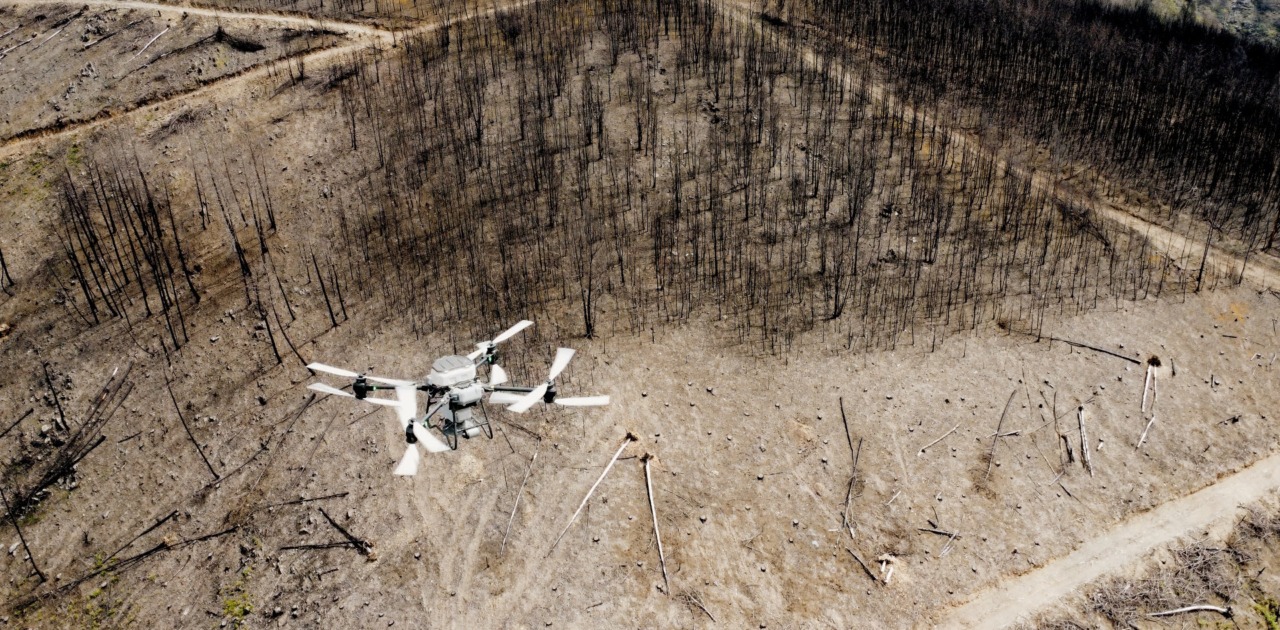
Seeding over a hundred hectares of burned mountain terrain is not simply a matter of flying a drone.
Taking on the Agras T50, our seeding drone, for the first time, while simultaneously covering more than a hundred hectares of charred, uneven ground, was an ambitious undertaking. The technical demands were significant on their own. But they existed alongside something more immediate: the physical reality of the work itself. Moving seed bags. Loading the drone. Rotating twelve-kilogram batteries. Walking across rocky, unstable terrain for hours at a stretch. It was as much a blast as a sweaty, physical effort.
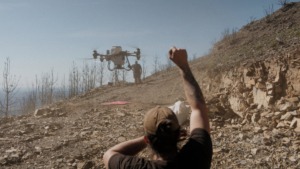
The first and most important lesson: Agras T50 is as much your average drone, as a remote-controlled toy car is your average road vehicle. Many UAVs (Unmanned Aerial Vehicles) offer flight windows of ten to forty minutes. The T50 gives the operator approximately seven and this constraint changes everything. It takes planning to a whole new level, actually turning it into a safety requirement. There’s no flight in Silveira that hasn’t been extensively mapped, planned and prepared, period.
How far can the aircraft travel from its take-off point and still return with adequate battery reserve? What margins account for wind, distance, and terrain? What happens when multiple variables start working against you at the same time? The answer to these questions came from real-world experience. The drone can operate comfortably up to around 600 meters from take-off, provided line of sight is maintained. Battery planning became a discipline in itself: if the drone is operating 500 meters away, the return journey alone can consume 20–25% of remaining charge. The goal then was always to land well before power levels became a concern, both for the machine’s safety and to avoid unnecessary stress on the battery cells.
Key operating principle: Plan for the return journey first. At 500 meters distance, budget 20–25% of battery capacity for return-to-home before calculating how much payload run is achievable.
Key Lessons
- Plan every flight for the return journey first. At 500 m distance, budget 20–25% of battery capacity before calculating usable payload time.
- The T50’s obstacle avoidance system can prevent landing on clear ground. On mountain terrain, anticipate it — don’t fight it.
- Trust the FPV controller feed, not the naked eye. Trees and ridgelines create false collision impressions that the feed corrects.
- RTK GPS is not optional on complex terrain. Without it, precise low-altitude flight becomes genuinely risky.
- Drone seeding at scale is a logistics operation. The aircraft is the most visible part — not the most demanding one.
What the Obstacle Avoidance System Does Not Tell You
The second major learning concerned the T50’s obstacle avoidance system, specifically how it behaves when landing. When triggered, it can prevent the aircraft from touching down even when the ground below appears perfectly clear. On mountain terrain, this creates moments of genuine uncertainty. It led to broken propellers, unplanned landings, and a growing respect for how sensitive the system actually is.
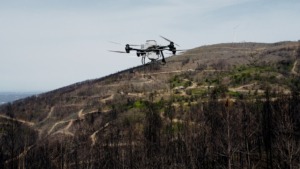
Equally critical was understanding the importance of the RTK — Real Time Kinematics — unit for GPS accuracy. Without reliable RTK positioning, precise low-altitude flight over complex terrain becomes far more difficult to manage safely. Once this became part of our standard operating procedure, a significant layer of risk was removed.
Watch the Feed, Not the Drone
The third lesson became something of a mantra.
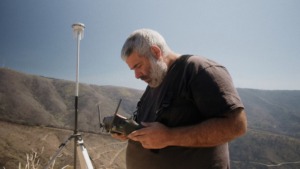
When flying the T50 over wooded mountain terrain, watching the aircraft directly can be actively misleading. Trees and ridgelines create the impression of imminent collision when no real hazard exists. The FPV controller feed tells a different story. One grounded in the aircraft’s actual position relative to its surroundings. Learning to trust the feed over instinct was the single most important shift in flying confidence across the entire operation.
The First Operation: Learning Without a Net
Previous experience with the Matrice 4E (a powerful, yet more conventional drone) for mapping provided a foundation, but it only went so far. Flying a heavy-lift seeding drone is a different discipline. In the absence of formal training, YouTube videos and direct experimentation filled the gaps, quite imperfectly. The result was three crash landings, each one a lesson in the drone’s highly sensitive obstacle avoidance system and the nuances that only become apparent through close contact with the machine.
The variables involved in each flight were more numerous than initially anticipated: terrain gradient, take-off location and access, wind and weather, potential radar deflections on landing, seeding distance, RTK signal strength, flight time management, route waypoint planning, and clearing jams in the seed hopper when they occurred. Each factor could, on its own, complicate an operation, but together they demanded a level of situational awareness that only came with time.
The Second Operation: Competence, Then Logistics
After formal training day with a professional trainer, the technical picture changed entirely. Knowing that expert support was available by phone made a difference that is difficult to overstate. Operations that had felt precarious became manageable. Procedures that had been improvised became systematic.
The challenges then shifted from the drone to the operation around it. A 250-kilogram generator does not load itself into a truck. Every morning, before a single flight took place, the team was already working: organizing equipment, designating landing sites, planning missions for the day’s terrain. Where needed, sites were machine-worked beforehand to create flat, stable surfaces for take-off and landing. Access roads that did not exist had to be made.
The preparation work was labour-intensive. But it made what followed possible:
More than 120 Hectares seeded — roughly 140 football fields of burned landMore than 2,800 Kilograms of seed dispersed across terrain largely inaccessible on foot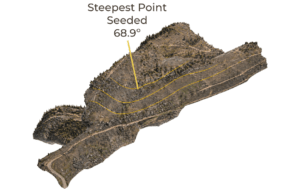
Much of that land could not have been reached by a ground crew within any practical timeframe. The slopes were unstable, the access limited, and the scale of coverage too great. The drone reached it in seven-minute windows, one payload at a time.
What the Technology Actually Demands
There is a version of drone seeding that looks, from the outside, like automation. The aircraft lifts off, covers the terrain, returns. Clean, efficient, almost effortless.
That version does not exist.
The T50 is a powerful machine. But every flight it completes is supported by people on the ground carrying 25-kilogram seed bags, rotating batteries, maintaining the generator, and packing everything into a truck before first light. What this operation ultimately demonstrated is that aerial drone seeding at scale is a logistics challenge as much as a technical one. The aircraft is the most visible part of the system, but not always the most demanding. If there is one thing that crash landings and broken propellers reliably teach, it is that technology performs in proportion to the discipline and care placed around it. The drone did not remove the hard work, but it allowed us to reach a scale we didn’t think possible in our wildest dreams.
And we’re only getting started!
Frequently Asked Questions
How many hectares can the DJI Agras T50 seed per day?
This depends heavily on terrain complexity, battery logistics, and team size. On our burned mountain land in Serra da Lousã — steep, rocky, with access roads that often had to be created — we averaged between 8 and 15 hectares per operational day across the full campaign. The drone itself is rarely the bottleneck; battery rotation, seed loading, and mission planning are.
What is the maximum range of the DJI Agras T50?
The T50 can operate comfortably up to approximately 600 metres from its take-off point, provided line of sight is maintained. At that distance, the return journey alone consumes 20–25% of remaining battery charge. In practice, we planned most missions within 500 metres to maintain safe margins.
Why does the DJI Agras T50 obstacle avoidance system prevent landing?
The T50’s obstacle avoidance is highly sensitive and can be triggered by terrain features, vegetation, or uneven surfaces — even when the landing zone appears clear. On mountain terrain this is a recurring challenge. The solution is to scout and, where needed, manually prepare flat stable landing surfaces. Switching to manual override is possible but requires experience.
Is RTK GPS necessary for agricultural drone seeding?
On complex terrain, yes. Without RTK (Real Time Kinematics) positioning, precise low-altitude flight becomes significantly more difficult to manage safely. RTK provides centimetre-level GPS accuracy, which matters when flying over steep slopes with variable terrain and limited recovery options if positioning drifts. We made it a standard operating requirement after early operations without it.
What training is required to operate the DJI Agras T50?
The T50 is a professional heavy-lift agricultural UAV — not a consumer drone. Our first operation was largely self-taught from documentation and YouTube, which resulted in three crash landings. After a formal training day with a certified instructor, operations that had felt precarious became systematic. For anyone planning seeding operations at scale, formal training before the first real mission is not optional.

23/03/2026
How Drones are Transforming Regeneration
08/10/2025
From a Humble Storage to an Off-Grid Basecamp
Learn how we work off-grid as well as the challenges and benefits this way of life brings!
27/08/2025
Serra da Lousã Burned. We Resisted.
On August 14th, at the peak of a brutal heatwave, a massive fire swept through the mountains of Lousã. In just a few days, over 3,500 hectares of mountain forest were reduced to ash. Our land was no exception.