Revitalizing the Agroforest
-
IN PROGRESS: 5%
-
LOCATION: Agroforest
-
BUDGET: 10,000€
-
ECOSYSTEM: Forest

-
IN PROGRESS: 5%
-
LOCATION: Agroforest
-
BUDGET: 10,000€
-
ECOSYSTEM: Forest
O b j e c t i v e s
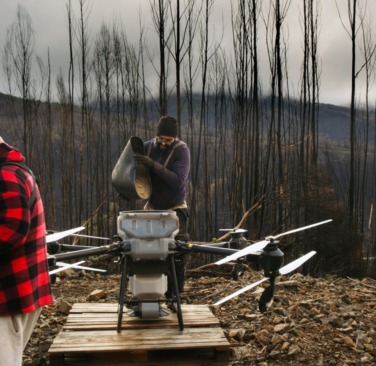
- Rebuild the agroforest after the August 2025 wildfire
- Restore soil life and structure on burnt slopes through intensive mulching, compost, and syntropic planting, turning fire‑scarred ground back into productive, moisture‑holding terraces
- Reinforce physical protection (fencing, layout, species choice) so the young system can withstand not only climatic extremes but also renewed pressure from wildlife such as deer
- Use the re‑planting as a living classroom, offering volunteers, students, and visitors a concrete example of how to respond regeneratively after catastrophic fire.
D e s c r i p t i o n
Discover the inspiring 16-month journey of our syntropic agroforest in Episode 21 of our YouTube series embeded below.
This ambitious project transformed degraded land overrun by invasive eucalyptus and mimosa monocultures – former village terraces eroded over decades – into a resilient ecosystem. Key efforts included rebuilding a leaky 1980s dam into a 1-million-liter reservoir for irrigation and wildfire defense, reshaping steep slopes into wider terraces with gentler angles, and planting diverse native Portuguese species: over 300 fruit trees alternated with fast-growing biomass plants and trees, vetiver grass barriers, sunflowers, phacelia for ground cover, and herbaceous pollinator attractors.
Community volunteers and teams applied Ernst Götsch’s syntropic principles – constant ground cover, plant consortia for mutual benefits, and strategic pruning – to accelerate natural succession, boost soil organic matter, and restore biodiversity, turning barren slopes green with life like tadpoles, salamanders, butterflies, and bees.
On August 15, 2025, a massive wildfire tested its design: while much burned, the Agroforest acted as a natural barrier, shielding our Basecamp, waterline, and pockets of green amid widespread devastation! It proved early resilience even before full maturity.
O u t c o m e s
The first agroforest proved that even a young syntropic system can slow fire, shield critical infrastructure, and preserve pockets of biodiversity, informing the design of the new, post‑fire version.
Natural regeneration is already visible—oaks resprouting, slopes turning green again—creating a stronger ecological base on which to re‑plant and diversify the terraces.