



05.03.2025.
R1 – The Heart of our Natural Regeneration Project
Intro
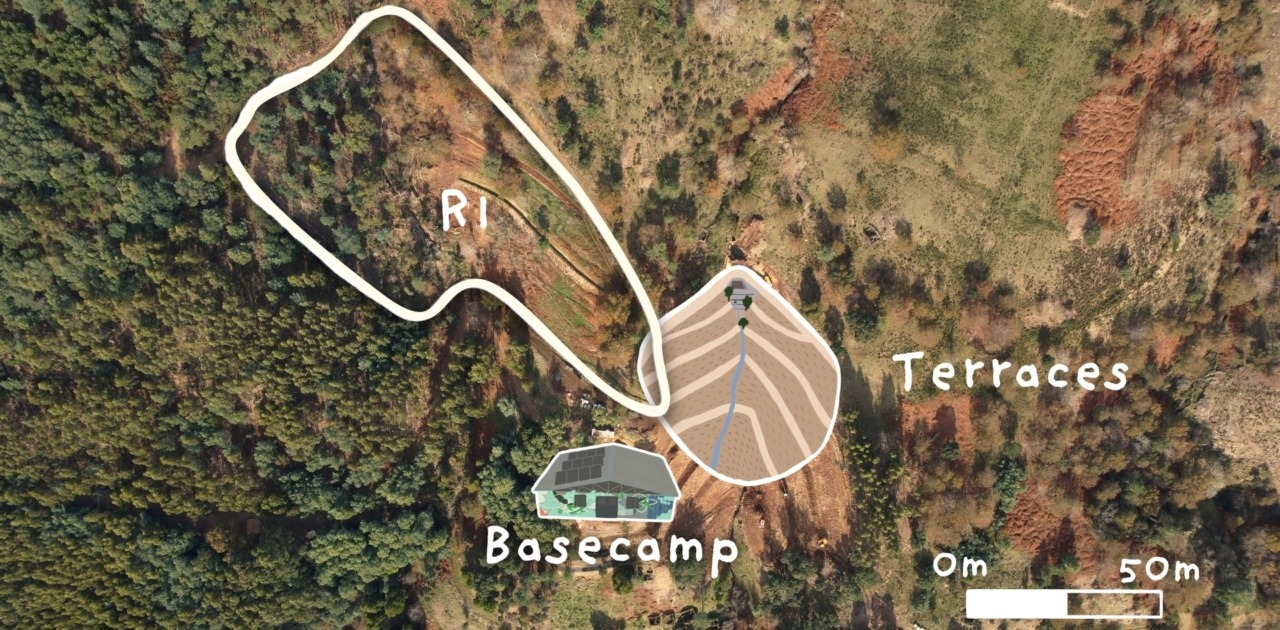
In the last few months we were able to give more love and care to the heart of our first regeneration area – the R1. It is an experimental zone, where we test different methods for planting native species and restoring degraded land. Our goal for this part of the project is to evaluate which techniques work best and to gather data that helps us decide whether these methods should be scaled up across other zones of our land.
We selected this area because it provides a representative sample of our landscape. It is close to our Basecamp, making it accessible for frequent monitoring, and it presents key challenges similar to the rest of the terrain
- It is steep and rocky.
- It has a secondary water line, which only holds water during the rainy months.
- It was previously dominated by invasive acacia and a patch of sick pines, requiring active restoration efforts.
Rapid Forest Regeneration with the Miyawaki Method
Within R1, we experiment with different planting strategies and observe how various factors affect plant survival and ecosystem regeneration. Our focus was to create a biodiverse system that integrates plants in a way that mimics natural ecosystems. This is where the Miyawaki planting method came into play.
Developed in the early 1970s by Japanese ecologist Akira Miyawaki, this method uses native tree species to form a diverse, multi-layered forest community. These trees complement each other, creating a resilient ecosystem that truly restores our forests with native trees.
The key principle of a Miyawaki Forest is its high density of seedlings. This mimics natural forest regeneration, where a fallen tree creates a gap in the canopy. Planted close together, saplings grow quickly to compete for sunlight. Over time, natural selection favors the fastest-growing individuals, thinning the forest naturally.
We chose the Miyawaki method for its rapid forest regeneration potential, but before we could begin, we had to face one major challenge: mimosas.
Clearing Mimosas, Cultivating Native Biodiversity
Many are surprised when we cut down trees during reforestation. But we’re only removing invasive species like mimosas. These trees spread quickly in Portugal, crowding out native plants by thriving in sunlit, degraded soils and blocking growth with their wide canopies. Cutting down invasive species like mimosas clears the soil, giving native plants a real chance to grow.
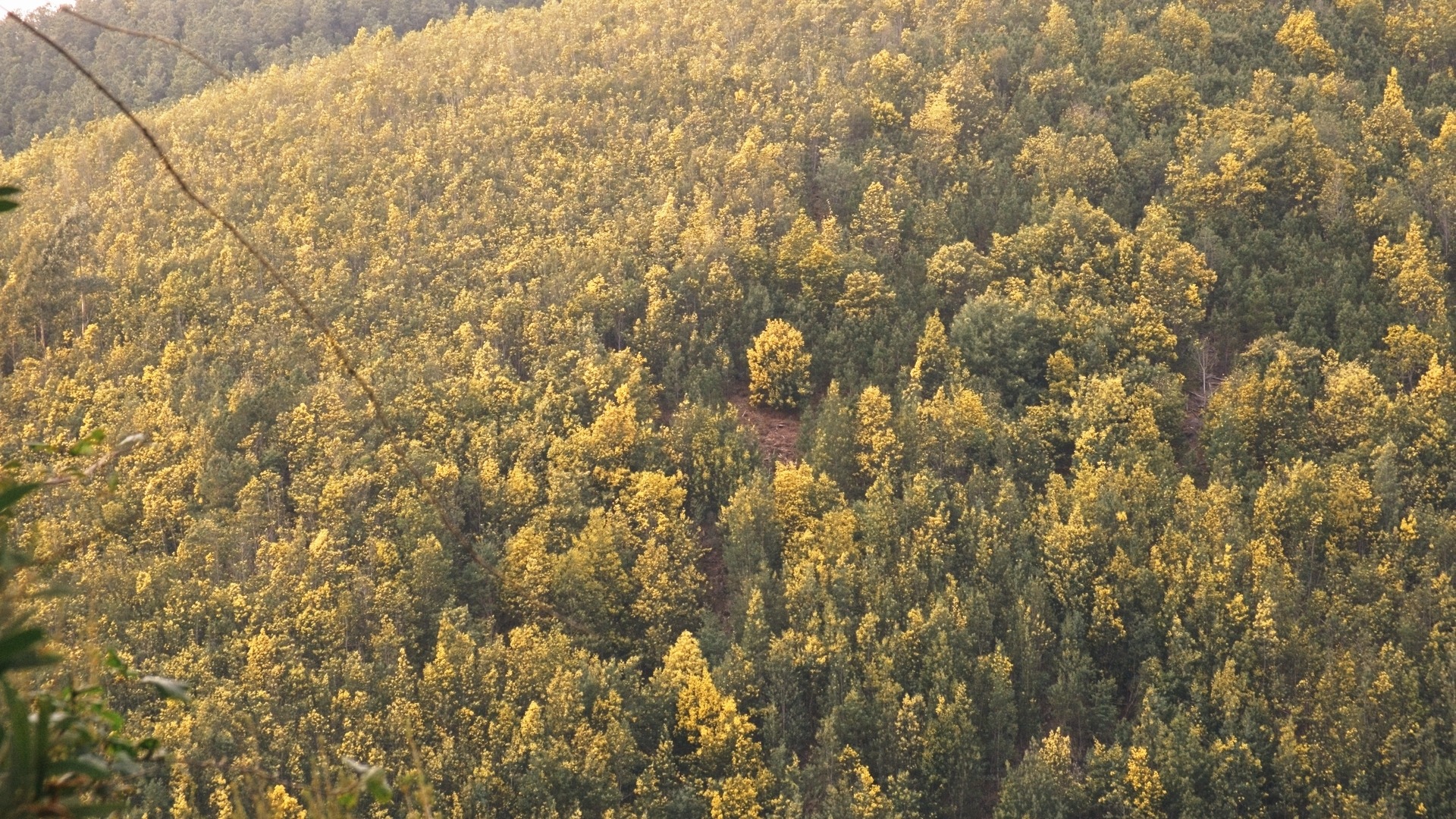
To restore our forest’s biodiversity, our first step was to clear out mimosas. Luckily, the tech-savvy Make it Digital team helped remove tons of branches and sticks – which we later woodchipped for mulch and other uses.
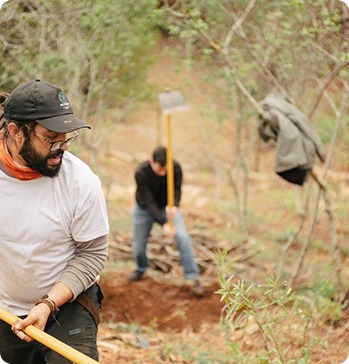
Once the area was cleared, we teamed up with Santa’s little helpers from Credisegur. Their energy and fun spirit helped us plant over 300 fast-growing native trees and bushes, chosen specifically to shade the soil and outcompete the mimosas that thrive in full sunlight. Big thanks to both teams for their enthusiasm and great work! We can wait to see the result of our united efforts!
Do you also want to transform your team-building experience and make a green impact? Reach out to us at: hello@silveiratech.pt
Don't Miss Our New Vlog! 🎥
Curious about our progress? Check out the latest Vlog episode on our YouTube channel and follow the intensive work of our team. We have many inspiring and funny moments for you. Don’t forget to subscribe! We’re just getting started.
Frequently Asked Questions
What is the Miyawaki method and how does it work?
Developed in the 1970s by Japanese ecologist Akira Miyawaki, this method plants native trees at very high density, typically 3–5 trees per square metre, to mimic the competitive dynamics of natural forest regeneration. Saplings compete for light, growing significantly faster than they would in low-density plantings. Natural selection gradually thins the stand, and within 10 years a Miyawaki forest can reach a state of ecological complexity that would take 100 years to develop naturally.
How fast does a Miyawaki forest grow?
In optimal conditions, Miyawaki forests typically grow 10 times faster and become 30 times denser than conventional plantations. In the first two years growth is slow as root systems establish. By years three to five, canopy closure begins. By year ten, the forest is largely self-sustaining and requires minimal management. In the dry summers of central Portugal, outcomes depend heavily on irrigation support in the early years.
Why do you cut down mimosa (Acacia dealbata) before planting?
Mimosa is a highly invasive species in Portugal that forms dense canopies, fixes excessive nitrogen (altering soil chemistry), and crowds out native species. Its fast growth in open, degraded soils means it will outcompete native seedlings if not removed before planting. Cutting mimosa before a Miyawaki planting is not deforestation, it is clearing an invasive monoculture to give native biodiversity a viable start.
Which native species do you plant in the R1 zone?
We select species appropriate to the altitude, slope aspect, and soil conditions of each micro-zone in R1. Typical species include native oaks (Quercus robur, Q. pyrenaica), strawberry trees (Arbutus unedo), wild olive, rockrose (Cistus spp.), and various native shrubs that provide early canopy and attract wildlife. Species that actively shade the soil and compete with mimosa regrowth are prioritised in the early planting phases.
Explore
Photo & video gallery


08/05/2026
More than 120 Hectares: Hardship and Victory on the Mountain
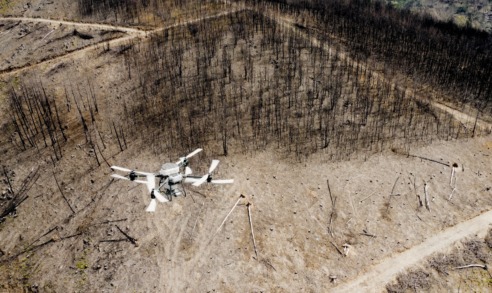
Taking on the Agras T50, our seeding drone, for the first time, while simultaneously covering more than a hundred hectares of charred, uneven ground, was an ambitious undertaking.

23/03/2026
How Drones are Transforming Regeneration
08/10/2025
From a Humble Storage to an Off-Grid Basecamp
Learn how we work off-grid as well as the challenges and benefits this way of life brings!